CALL FOR RESEARCH GROUP MEMBERS
DIMENSIONS OF FEMINISED CORRUPTION IN AFRICA.
As gender equality discourses provided reawakened visibility for women and some opportunities to show how well they can contribute to leadership, this development is accompanied by public scrutiny of women’s competencies and women’s moral commitment to leadership and good governance, which when deployed in toxic senses exposes women to a new dimension of violence. Ahead of the realisation of the expected dividends of gender mainstreaming, ‘feminised corruption’ reveal attempts to scuttle gender parity (Omotoso, 2023, 2024). This could emanate as scrutiny of women in office by whistleblowers including political stalwarts, media, international agencies and ordinary citizens.
Feminised corruption emerges as a concept to spotlight the subtle operationalisation of various dimensions of corruption charges against women so that masculinised spaces are sustained. It results in performances, constructions and distortions of corruption charges levelled against women. Consequently, this needs to be interrogated across Africa to understand the trends, intensity and frequency which would affirm or dispel the claim that corruption is weaponised to thin out the few women in leadership and to deter other women from entering the space.
Some studies on gender-corruption linkage have found women less corrupt, while others argue for insufficient evidence to claim that men are more corrupt than women, as this could be subject to varying factors and situations. One question that stands out here in the gender and corruption debate is, are women as much looters as the men?
‘Feminised Corruption’ was first discussed in 2023 in an article published on “Media Transnationalism and the politics of ‘Feminised Corruption’”. It called attention to an emerging pattern used for women’s subtle exclusion from political arena in Nigeria.
Three major claims form the discursive fulcrum of the concept. The first claim is that, since 1999, when Nigeria returned to the comity of democratic countries of the world, after a long period of military rule, the democratic political space has been largely masculinised. The second claim is that there is a high-level corruption in the masculinised democratic political space in Nigeria. The third claim is that there seem to be a feigned commitment to mainstreaming gender in Nigeria’s politics, as the few women at top political echelons continue to crash land in the face of corruption scandals. This is signalled by a twist in the operations of gender parity policies across successive administrations, as well as a high level of unpreparedness of the men to embrace inherent changes brought by women’s entry into political spaces. It gives the impression that gender mainstreaming in Nigeria’s politics was devoid of a de-masculinization agenda.
Why a Research Group on Feminised corruption?
Feminised corruption has been largely discussed within Nigerian contexts. This research group seeks to widen the scope of the concept of feminised corruption as a contribution to scholarship while also developing newer parameters in understanding and addressing corruption across Africa. The intention of this research group is neither to show that women are the fairer sex with regards to corruption, nor to use a deficit approach that makes women’s entrance into hitherto masculinised spaces a magic wand to fix the problems, however, it is a call to identify an emerging trend which should not be downplayed in the growing scholarship on women’s political representation, participation in leadership, and gender parity across spaces beyond politics.
We seek a continental spread of the study on feminised corruption by building a strong research group on feminised corruption. This is best drawn on multidisciplinary and transdisciplinary criteria.
Eligibility
Members of the research group will be drawn from scholars and researchers working on Africa regardless of nationality or geographical location, but with specific interest in studies on corruption in Africa across disciplines including economics, politics, psychology, sociology, information and digital technology, religion, education among others. Mixed method of research will be engaged to afford a collection and analysis of both qualitative and quantitative data in the study.
Aim and Proposed Output
The research group will provide a space for academic engagements covering methodological, theoretical, conceptual, ethics and policy discourses. Also, the research group will provide a mentoring platform for early career researchers and create a platform for conducting cutting-edge research. Among other research outputs that members may personally pursue, the research group aims to produce an edited book and a policy brief on dimensions of feminised corruption across Africa. These will enrich the growing literature on the concept so that scholars can further engage with and expand the new body of knowledge offered.
Timeline
The first phase of this project is June 2025-May 2026
References
Omotoso, S. A. (2023): Media Transnationalism and the Politics of ‘Feminised Corruption’. University of Bayreuth African Studies Working Papers 34, Academy Reflects 8. Bayreuth: Institute of African Studies. 32pp. https://doi.org/10.15495/EPub_UBT_00006826
Omotoso, S. A. (2024): “When ‘She’ is The Crook: Feminised Corruption and Women’s Political Communication in Nigeria”. In A. Oyelude & O. Eweka (eds.) WORDOC Seminar Series 2024. Readings from The Ibadan School of African Feminist Studies. Ibadan: Institute of African Studies.46-85pp. Ibadan: Institute of African Studies. ISBN 978-9-7878-0384-4. https://repository.ui.edu.ng/server/api/core/bitstreams/c01283cb-3dae-4dd7-b6d2-be6a1f9e5241/content
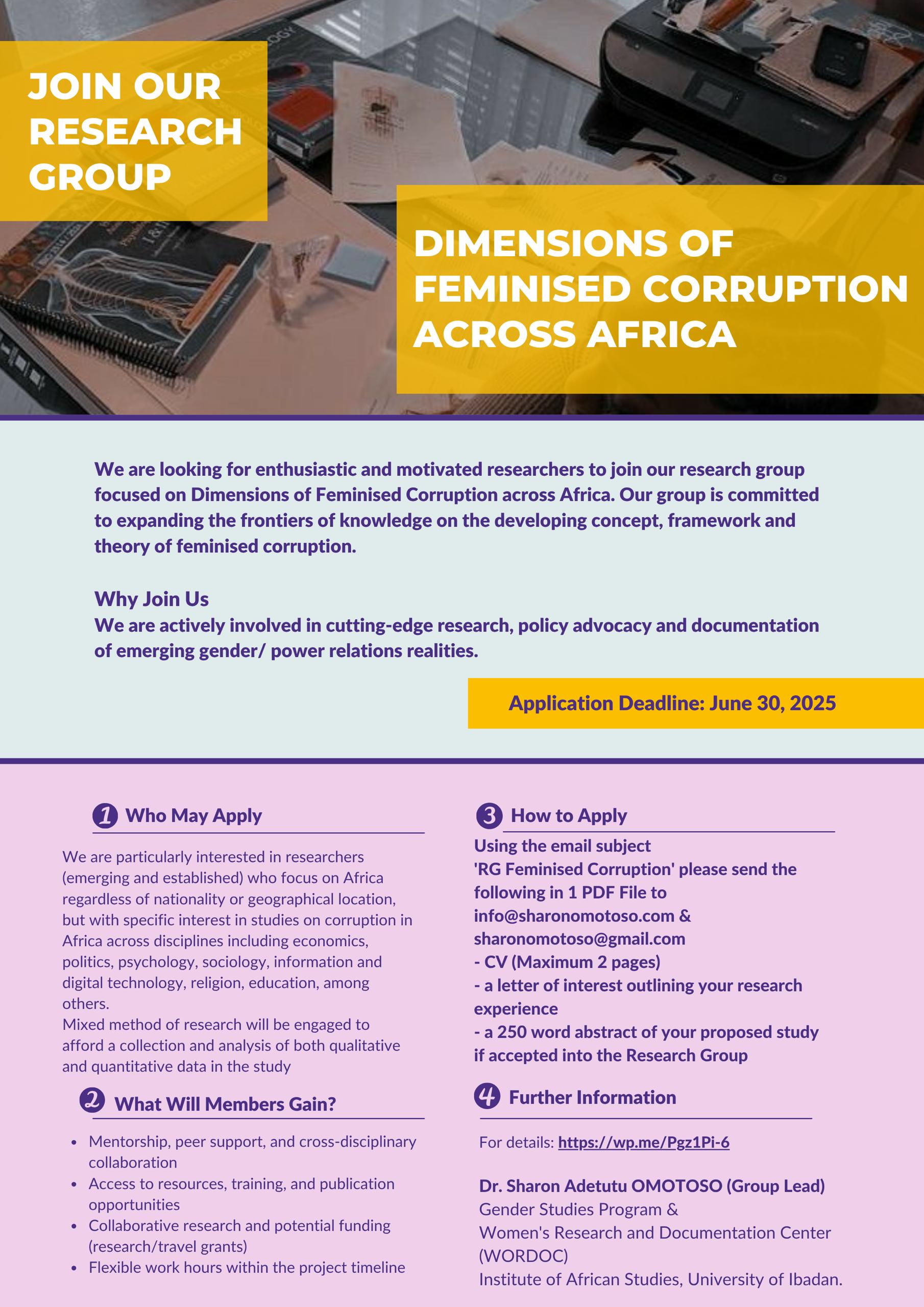
We are looking for enthusiastic and motivated researchers to join our research group focused on Dimensions of Feminised Corruption across Africa. Our group is committed to expanding the frontiers of knowledge on the developing concept, framework and theory of feminised corruption.
Why Join Us?
We are actively involved in cutting edge research, policy advocacy and documentation of emerging gender/power relations realities. Members will have
- Opportunity to work with renowned researchers across disciplines
- Mentorship for early career researchers
- Peer mentoring and reviews across disciplines
- Access to resources in the core research areas of gender and corruption
- Cross-country collaborative research for comparative studies on feminised corruption
- Avenue for publication in reputable academic platforms
- Participation in seminars and trainings including science communication, research methodology, policy advocacy e.t.c.
- Potentials for research grants, travel grants and other funding opportunities
- Flexible work hours within the timeframe of the project
Who may apply?
We are particularly interested researchers (emerging and established) who focus on Africa regardless of nationality or geographical location, but with specific interest in studies on corruption in Africa across disciplines including economics, politics, psychology, sociology, information and digital technology, religion, education among others. Mixed method of research will be engaged to afford a collection and analysis of both qualitative and quantitative data in the study.
How to Apply
Using the email subject ‘RG Feminised Corruption’, please send the following in 1 PDF File to
- Your CV (Maximum 2 pages)
- a letter of interest outlining your research experience
- a 250 word abstract of your proposed study if accepted into the Research Group
The application deadline is June 30, 2025.
For details: https://wp.me/Pgz1Pi-6
Dr. Sharon Adetutu OMOTOSO (Group Lead]
Gender Studies Program
&
Women’s Research and Documentation Center (WORDOC)
Institute of African Studies
University of Ibadan, Nigeria
Appointments, Consultancies & Invitations
Please email me: info@sharonomotoso.com
 Sharon Adetutu Omotoso